
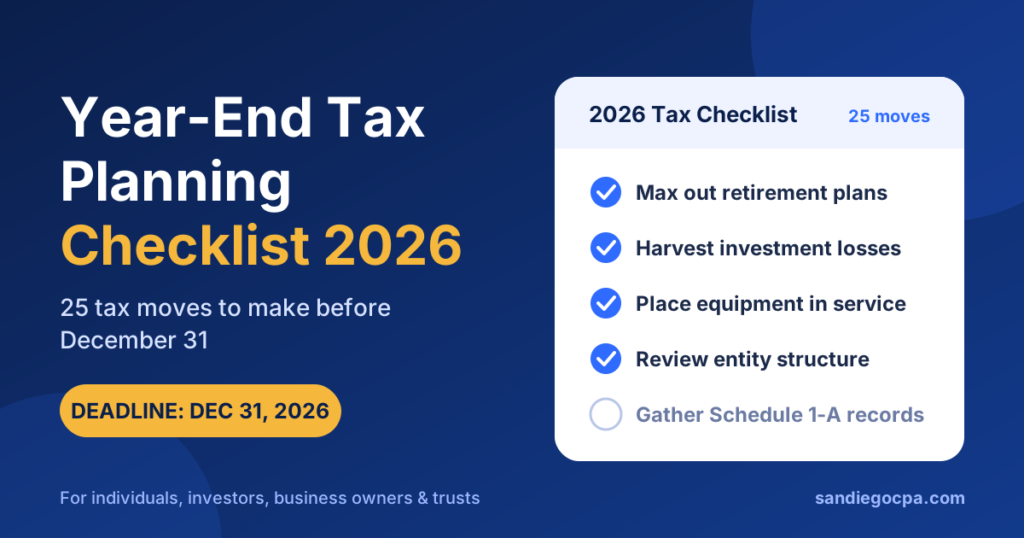
Year-end tax planning is the process of reviewing your income, deductions, and investments before December 31 to lower your 2026 tax liability. Most tax-saving strategies have a hard calendar deadline. By January, you can only report what already happened. Right now, you can still change it.
2026 is also a year of real change. Older checklists are out of date because the new federal tax law has taken effect and many figures were updated. This guide walks through 25 tax moves for individuals, investors, business owners, and trusts, using current figures from the IRS and other published sources.
Timing tip: Start in October or November. Waiting until December 31 to review your finances limits your options, because many strategic opportunities have passed by then.
What’s New for 2026 at a Glance
Area |
2026 Change |
|---|---|
| Standard Deduction | $32,200 for married couples filing jointly, $16,100 for single filers, and $24,150 for heads of household. |
| SALT Cap | The state and local tax deduction cap rises from $10,000 to $40,000, then grows 1% a year through 2029. |
| QBI Deduction | The 20% qualified business income deduction is now permanent, with a new $400 minimum for taxpayers with at least $1,000 of QBI. |
| Equipment Write-Offs | The Section 179 limit is $2.5 million (indexed for inflation after 2025), and 100% first-year bonus depreciation is permanent for qualified property acquired after January 19, 2025. |
| Schedule 1-A Deductions | Deductions for tips, overtime, car loan interest, and seniors, each with income phase-outs, effective from 2025 through 2028. |
| Charitable Giving | Starting in 2026, non-itemizers can deduct up to $1,000 in cash gifts ($2,000 for joint filers). |
| 401(k) Limit | $24,500, up from $23,500, with an $8,000 catch-up contribution for workers aged 50 and older. |
Checklist for Individuals & Families (Moves 1–9)
1. Project your 2026 and 2027 income. Compare your taxable income this year with next year. If you expect a higher tax bracket in 2027, consider pulling income into 2026. If lower, consider deferring it. For reference, the 24% bracket begins above $105,700 for single filers and $211,400 for joint filers in 2026.
2. Max out your 401(k), 403(b), or 457 plan. The 2026 employee deferral limit is $24,500, and workers 50 and older can add $8,000. Savers aged 60 to 63 can contribute an extra $11,250 under a special catch-up provision.
3. Fund your IRA and HSA. The IRA limit is $7,500 for 2026. Starting in 2026, bronze and catastrophic health plans count as HSA-compatible, which opens HSA contributions to more people.
4. Review withholding and estimated tax payments. A job change, bonus, or investment sale can leave you under-withheld. The IRS Tax Withholding Estimator now reflects the new law’s changes, so use it before year-end to avoid underpayment penalties.
5. Time your charitable giving. With higher standard deductions, routine giving may not reduce your taxes. Consider “bunching” two years of gifts into one or donating appreciated stock. Non-itemizers can now deduct up to 1,000incashgifts(2,000 for joint filers), but gifts to donor-advised funds don’t qualify. Itemizers face a new floor: only gifts above 0.5% of adjusted gross income (AGI) are deductible starting January 1, 2026.
6. Decide whether to itemize. The higher SALT cap, mortgage interest, property taxes, and charitable gifts may accumulate differently than in previous years. Compare your total to the standard deduction before you commit.
7. Gather records for Schedule 1-A deductions. Eligible taxpayers may claim:
- Up to $25,000 of qualified tips
- Up to 12,500ofqualifiedovertime(25,000 for joint filers)
- Up to $10,000 of interest on a qualifying U.S.-assembled personal-use vehicle loan
- An additional $6,000 deduction for taxpayers age 65 and older, phasing out above
- 75,000ofmodifiedAGI(150,000 joint)
Phase-outs apply, and you’ll need your Social Security number and the vehicle’s VIN for the car loan deduction. Keep pay stubs, tip records, and lender interest statements.
8. Take required minimum distributions (RMDs). If you’re subject to RMDs, they generally must be taken by December 31 to avoid a penalty.
9. Use your family and education benefits. For 2026, the Child and Dependent Care Credit rate rises from 35% to 50% of qualifying expenses. Also review FSA balances, 529 contributions, and Trump Account options. Trump Accounts allow contributions of up to $5,000 a year, with employers able to add up to $2,500.
Checklist for Investors & Property Owners (Moves 10–14)
10. Harvest investment losses. Realized losses can offset capital gains, and up to $3,000 of excess losses can offset ordinary income. Review short-term vs. long-term gains, since they’re taxed differently.
11. Avoid wash-sale traps. Buying the same or a substantially identical security within 30 days of selling it at a loss can disallow the loss.
12. Estimate tax on large sales. If you sold a business, real estate, or a large stock position, estimate the tax now and make payments before year-end.
13. Pay deductible rental property expenses. Pay repair bills and property costs before December 31, and confirm depreciation schedules are correct.
14. Consider a cost segregation study. For commercial or larger rental properties, reclassifying building components into shorter depreciation lives can accelerate deductions.
Checklist for Business Owners & Self-Employed (Moves 15–22)
15. Place equipment in service by December 31. Equipment must be placed in service, not just ordered, to count for 2026. Companies can immediately expense up to $2.56 million of qualifying purchases for tax year 2026, up from $1.25 million in 2025. The deduction begins to phase out once total qualifying purchases exceed $4 million. Review vehicle weight and business-use rules before buying.
16. Review your entity structure. An S corporation election can reduce self-employment tax for profitable owners. Any restructuring must be completed before December 31 to apply for that tax year.
17. Check your state’s pass-through entity (PTE) tax election. Many states let S corporations and partnerships pay state tax at the entity level so it’s deductible federally. Rules and deadlines vary by state. For example, California extended its PTE elective tax for taxable years beginning on or after January 1, 2026, and before January 1, 2031.
18. Time income and expenses. If 2026 was a high-income year, consider deferring invoices into January while accelerating deductible spending into December: prepay rent, buy supplies, and pay vendor bills. Accrual-basis businesses have less flexibility.
19. Fund a business retirement plan. The 2026 SIMPLE IRA limit is $17,000. The annual limit for defined contribution plans such as Solo 401(k) and profit-sharing plans rose from $70,000 to $72,000. Plan setup deadlines vary, so act early.
20. Estimate your QBI deduction. The 20% QBI deduction is now permanent for eligible pass-through owners. Wages, property, and income thresholds can limit it, so run the numbers before December.
21. Clean up your books and confirm 1099 compliance. Reconcile accounts, categorize expenses, and separate personal from business spending. Collect W-9s from contractors. If you use payment apps, note that backup withholding on third-party network payments applies only when a payee receives more than $20,000 and more than 200 transactions in a year.
22. Use employer benefits and credits. The employer-paid family and medical leave credit was permanently expanded. Employers can also help employees repay student loans tax-free within a combined $5,250 educational assistance limit for 2026.
Common Year-End Tax Mistakes
- Waiting until January, when most strategies have expired
- Buying equipment in late December but not placing it in service
- Mixing personal and business finances
- Ignoring estimated tax shortfalls
- Missing the entity-structure deadline
- Chasing one deduction without looking at the full tax picture
Why Work With a San Diego CPA on Year-End Tax Planning
A tax professional looks at the whole picture: income, investments, business, family, and estate. At San Diego CPA, we have more than 8 years of experience, have prepared 5,000+ individual and business tax returns, and maintain a 98% client retention rate. Our 365 days of tax advisory support means you can reach us when a decision comes up, not only in tax season. We serve clients in all 50 states.
Book Your Year-End Tax Planning Review
Don’t wait until April to learn what you could have done in December. Call (619) 880-9453 or contact us today to schedule your review.
Frequently Asked Questions
1. When should I start year-end tax planning?
October or November. The earlier you start, the more options you have.
2. What is the deadline for year-end tax moves?
Most strategies must be completed by December 31, 2026. Some, such as IRA contributions, can extend to the filing deadline.
3. Does the higher SALT cap mean I should itemize?
Not necessarily. Compare your total itemized deductions to the standard deduction, and check whether income-based limits reduce your cap.
4. What is Schedule 1-A?
It’s the form for the new deductions on tips, overtime, car loan interest, and the enhanced senior deduction. Income limits and documentation requirements apply.
5. Can I handle year-end tax planning myself?
Many people can handle parts of it. A CPA helps when you own a business or property, have complex income, or are making large transactions.