
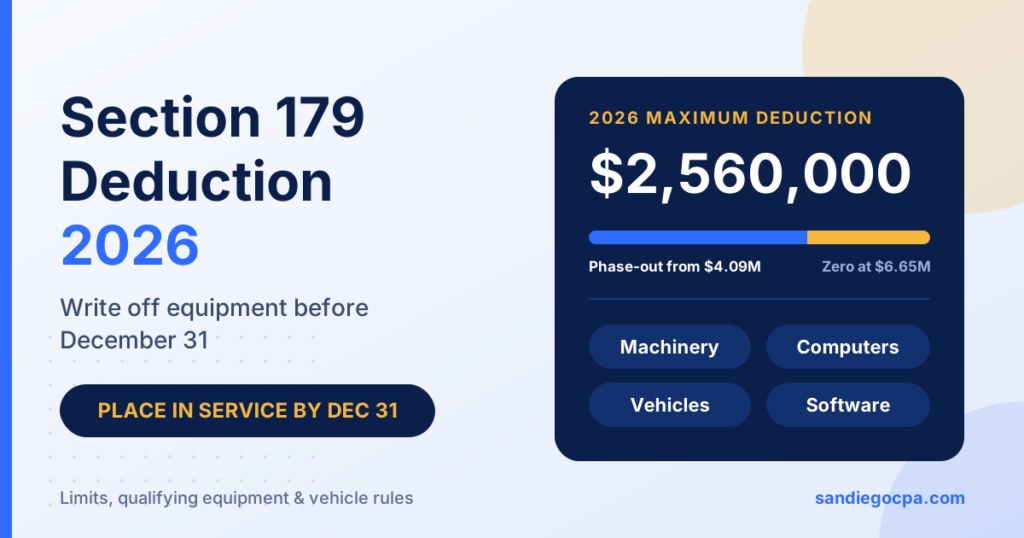
If your business needs equipment, buying it before December 31 could let you deduct the full cost on your 2026 tax return instead of spreading it over many years. That is the Section 179 deduction, and it is larger in 2026 than it has ever been.
The deadline is strict, though. Equipment must be placed in service by December 31, not merely ordered. This guide covers the 2026 limits, what qualifies, how Section 179 compares with bonus depreciation, and the vehicle rules that trip up business owners.
Equipment purchases are Move 15 in our year-end tax planning checklist 2026, so if you haven’t reviewed your full list of year-end moves, start there.
What Is the Section 179 Deduction?
Section 179 of the Internal Revenue Code lets a business elect to deduct the full purchase price of qualifying equipment and property in the year it is placed in service, instead of depreciating it over several years. The result is a lower taxable income and a smaller tax bill this year, plus more cash to reinvest.
Section 179 Limits for 2026
The One Big Beautiful Bill Act raised the Section 179 base limit to $2.5 million, indexed for inflation after 2025. The IRS says the amount is reduced dollar for dollar once total qualifying purchases exceed $4 million. For 2026, the indexed figures are:
2026 Section 179 Figure | Amount |
|---|---|
| Maximum Deduction | $2,560,000 |
| Phase-Out Begins | $4,090,000 of qualifying property placed in service |
| Fully Phased Out | $6,650,000 |
| Heavy SUV Cap (6,001–14,000 lbs) | $32,000 |
Most small and mid-sized businesses fall well below the phase-out, so they can deduct their full qualifying purchases. If you spend more than $4.09 million, the limit shrinks by every dollar above that threshold, and bonus depreciation can pick up the rest.
What Equipment Qualifies?
- Property generally qualifies if it is tangible, used in an active trade or business, and used more than 50% for business. Common examples:
- Machinery and manufacturing equipment
- Computers, servers, and office equipment
- Furniture and fixtures
- Tools and diagnostic equipment
- Off-the-shelf software
- Certain business vehicles
- Both new and used equipment
Land, buildings, and inventory do not qualify. Property you use personally more than half the time does not qualify either.
The “Placed in Service” Rule
This is the most common year-end mistake. Equipment must be placed in service, not merely ordered, to count for 2026. “Placed in service” means the asset is delivered, installed if needed, and ready and available for its intended use.
A realistic timeline:
- Early November: Place the order, because supply chains and installation take time.
- Late November to mid-December: Delivery, setup, and testing.
- By December 31: The equipment is in use, and you keep the paperwork (invoice, delivery receipt, and installation date).
Ordering a machine on December 28 that arrives in January earns no 2026 deduction.
Section 179 vs. Bonus Depreciation
Both let you write off equipment quickly, but they work differently.
Feature | Section 179 | Bonus Depreciation |
|---|---|---|
| 2026 Rate or Limit | Up to $2,560,000 | 100% |
| Applies To | Asset-by-asset election | Automatic unless you opt out |
| Income Limit | Cannot exceed business taxable income | No income limitation |
| Can Create a Loss | No | Yes |
| Phase-Out | Begins at $4,090,000 | None |
| Carryforward | Disallowed amounts carry forward | Not applicable |
The One Big Beautiful Bill Act made 100% first-year bonus depreciation permanent for qualified property acquired after January 19, 2025. In practice, many businesses use Section 179 first, then let bonus depreciation absorb what remains.
Which should you use?
- Profitable business with moderate purchases: Section 179 gives you precise control over which assets to expense.
- Loss year, or a deduction larger than your income: Bonus depreciation can create or increase a loss. Section 179 cannot.
- Purchases above $4.09 million: Rely on bonus depreciation as Section 179 phases out.
Business Vehicle Rules
Vehicle weight (gross vehicle weight rating, or GVWR) decides how much you can deduct in year one.
Vehicle Type | 2026 First-Year Treatment |
|---|---|
| Cars and Light Trucks (6,000 lbs or Less) | Luxury-auto limits apply: $20,300 with bonus depreciation, $12,300 without. |
| Heavy SUVs (6,001–14,000 lbs) | Section 179 capped at $32,000, with 100% bonus depreciation available on the remaining cost. |
| Trucks with Beds of 6+ Feet and Vans Seating 10+ | Generally exempt from the SUV cap. |
| Vehicles Over 14,000 lbs | Not subject to the SUV cap (commercial treatment). |
Example: A $90,000 SUV rated at 7,200 lbs GVWR, used 100% for business and placed in service in 2026, produces a $32,000 Section 179 deduction plus $58,000 of bonus depreciation, for a $90,000 first-year total.
A passenger car under 6,000 lbs with the same price is limited to the luxury auto cap, a small fraction of the cost.
Business use must exceed 50%, and personal use reduces the deductible amount. Keep a mileage log.
The Business Income Limit
Section 179 cannot exceed your net business income for the year. For instance, a sole proprietor with $18,000 of net business income who buys a $75,000 heavy SUV can deduct only $18,000 under Section 179 this year, because the income limit applies on top of the $32,000 SUV cap. Disallowed amounts can carry forward, and bonus depreciation may help in a low-income year. Discuss this with your CPA before buying.
Who Benefits Most?
- Sole proprietors and single-member LLCs: Claim it on Form 4562 with Schedule C.
- S corporations and partnerships: The deduction passes through to owners, subject to limits at the owner level.
- C corporations: Eligible as well.
- Contractors, manufacturers, medical and dental practices, restaurants, trucking, and eCommerce businesses: Often have the most equipment to buy.
State Tax Differences
Some states, including California, do not fully follow the federal Section 179 and bonus depreciation rules. You may get a smaller deduction on your state return, which means keeping two sets of depreciation records. Ask your CPA how your state treats the purchase before you buy.
Common Section 179 Mistakes
- Ordering without placing in service by December 31.
- Overestimating vehicle deductions. Check GVWR on the door-jamb label before assuming the SUV rules apply.
- Ignoring the business income limit.
- Buying only for the deduction. A deduction saves a portion of the cost, not all of it, so buy what the business actually needs.
- Weak documentation. Keep invoices, delivery and in-service dates, and business-use logs.
- Forgetting state conformity.
Year-End Equipment Purchase Checklist
- List the equipment your business actually needs.
- Project your 2026 business income to confirm the deduction will be usable.
- Confirm each asset qualifies and will be used more than 50% for business.
- Check vehicle GVWR and the applicable caps.
- Place orders early, and confirm delivery and installation dates.
- Get each asset into service before December 31.
- Save invoices, in-service records, and business-use logs.
- Have your CPA elect Section 179 on Form 4562 and coordinate it with bonus depreciation.
Plan Your Equipment Purchases With a CPA
The right mix of Section 179, bonus depreciation, and timing depends on your income, entity type, and state. At San Diego CPA, we have more than 8 years of experience, have prepared 5,000+ individual and business tax returns, and provide 365 days of tax advisory support for clients in all 50 states.
Planning a purchase before year-end?
Contact Us Today to Review Your Options Before December 31.
Frequently Asked Questions
1. What is the Section 179 limit for 2026?
$2,560,000, phasing out dollar for dollar once total qualifying purchases exceed $4,090,000.
2. Do I deduct the full amount in one year?
Yes, up to the limits, if the equipment is placed in service in 2026 and you make the election. The deduction cannot exceed your net business income, with excess carried forward.
3. Can I deduct used equipment?
Yes. Both new and used equipment can qualify.
4. What if I finance the equipment?
Financed purchases generally still qualify. The deduction is based on the cost of the property placed in service, not on how much you have paid.
5. Is Section 179 better than bonus depreciation?
Neither is always better. Section 179 offers asset-by-asset control but is limited by income. Bonus depreciation has no income limit and can create a loss. Many businesses use both.